
Ceramic Frit in Waterproof Engobe: Firing Temperature, CTE and Compatibility
Technical selection points for frit choice in waterproof engobe — firing window, thermal expansion, body compatibility and blistering tendency.
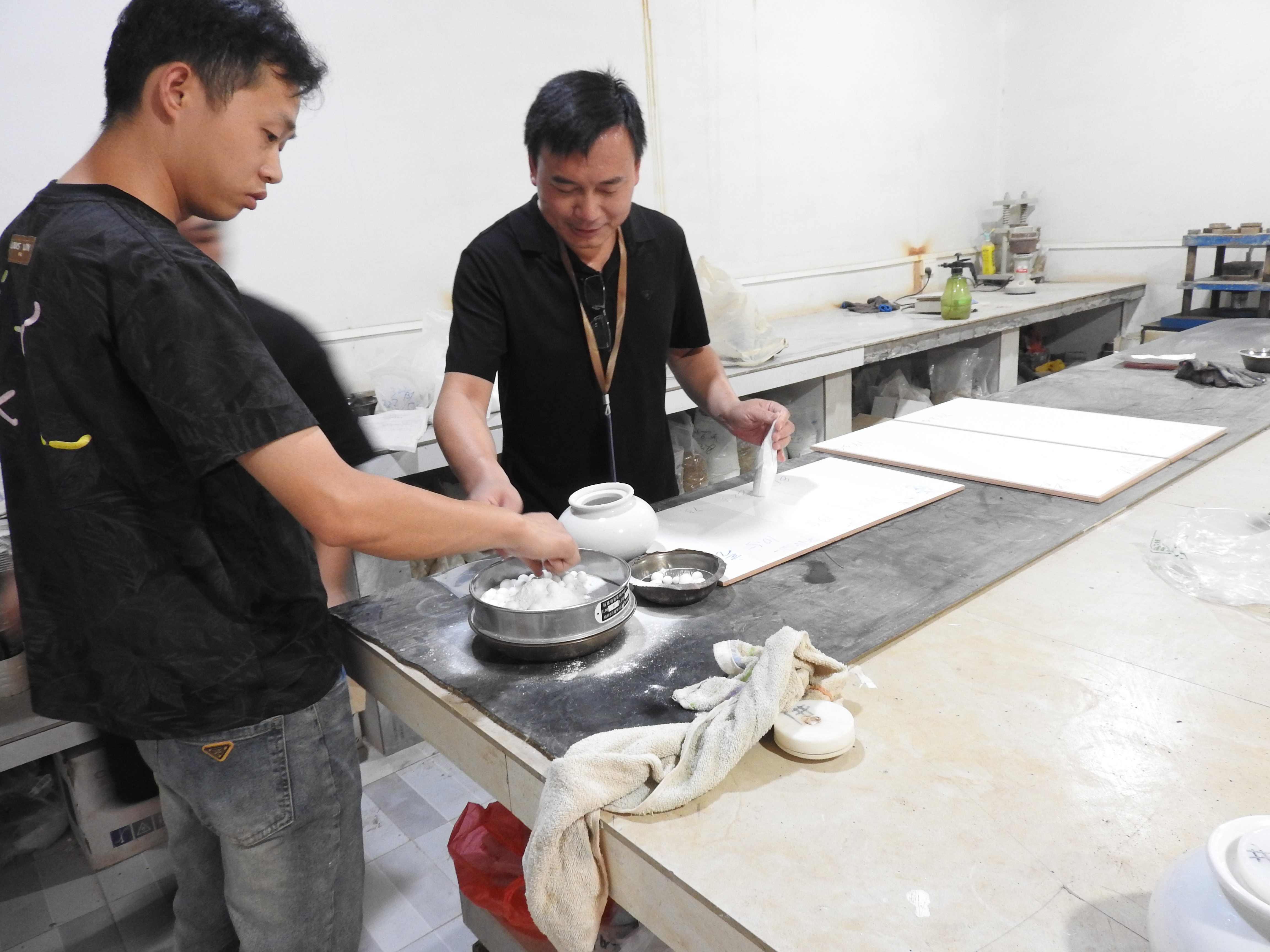
Production trial support: frit and engobe adjustments are evaluated on the customer's own body, kiln and firing curve.
The Short Answer
Selecting a ceramic frit for a waterproof engobe comes down to four coupled variables: firing window, thermal expansion, body compatibility and blistering tendency. Low-temperature, low-expansion engobe formulations are generally built around the 1050–1100 °C window. Titanium frits RFT8-7-HL and RFT8-7-HH are specified in the 1080–1180 °C window, and RFT8-7-HH carries a reference CTE value of 290.
None of these variables can be optimised in isolation. A frit that closes the layer cleanly at 1060 °C may blister at 1160 °C. A frit whose expansion sits close to the body may still develop poor whiteness if the opacifier loading is wrong. The working sequence is therefore: fix the firing window from the kiln and body, check expansion against the full three-layer stack, confirm compatibility in a trial fired at the top of the window, and only then scale.
This article deals with the engineering side of that decision. It does not restate what an engobe layer is; it addresses how the frit inside the layer is chosen, what each specification actually tells a factory technician, and where the common failure modes come from.
What a Waterproof Engobe Has to Do
A waterproof engobe is the intermediate layer applied between the ceramic body and the decorative glaze. It has to do three things at once: limit water penetration into the body, bond reliably to the layer below and the layer above, and provide a stable white or light background so that the glaze colour reads correctly.
Each requirement pushes the formulation in a different direction. Low permeability needs a well-developed glass phase, which raises shrinkage and stress. High whiteness needs opacifier loading, which thickens the slurry and changes how the layer behaves at peak temperature. Strong bonding needs some reaction with the body, and too much reaction produces blistering and pinholes. Frit selection is where these trade-offs are resolved, because the frit is the component that decides at what temperature the glass phase forms and how the fired layer expands and contracts afterwards.
The Four Jobs Ceramic Frit Does in a Waterproof Engobe
Ceramic frit is a pre-melted, quenched and milled glass. Using it instead of raw fluxing minerals gives the formulator a material whose behaviour was fixed at the melting stage, so the engobe matures within a narrower and more repeatable range. In a waterproof engobe that predictability matters in four areas.
- Glass-phase formation and maturing temperature. The frit supplies the fluxing components that let the layer seal within the specified window. Raw fluxes react inside the kiln and vary with the body batch; a frit has already reacted.
- Thermal expansion control. The frit is the largest single lever on the expansion of the fired layer, and therefore on the stress that develops between body, engobe and glaze during cooling.
- Opacification and background colour. Titanium and zirconium frits carry the opacifying phase that determines whiteness and the base tone on which the cover glaze develops its colour.
- Stress accommodation. The glass composition of the intermediate layer affects how far it can deform without opening cracks, which is what makes an engobe forgiving of small differences between body batches.
These roles are distributed across different frit families rather than concentrated in one grade. RENOVA INDUSTRIAL & TRADING CO., LTD supplies titanium frit, zirconium frit, boron frit, engobe frit, transparent frit, opaque and matte frits, polishing and wear-resistant frits, and silica-free quartz frit, with selection depending on the intended application and the customer's production conditions.
Why Frit Choice Is Now a Procurement Question, Not Only a Lab Question
Two published market observations frame the sourcing context. Future Market Insights (2025) reports that alkaline-boron frit held 38.7% revenue share of the ceramic frit market, making it the dominant product type. Market Research Future (2023) places China at roughly 65% of global ceramic frit production and market share. Absolute market-size estimates differ widely between research providers depending on what product scope is counted, so those valuations are best read as directional rather than as budgeting inputs.
For a factory specifying a waterproof engobe, the practical consequence is narrower than the market headline. A concentrated supply base means that the supplier's ability to adjust a formulation to a specific body, kiln type, firing temperature and production process weighs as much as the catalogue grade itself. A data sheet that matches on paper but cannot be tuned on the customer's line leaves the factory to absorb the difference.
Firing Temperature: Two Working Windows
Two working windows cover most waterproof engobe projects: 1050–1100 °C for low-temperature, low-expansion applications, and 1080–1180 °C for titanium frits RFT8-7-HL and RFT8-7-HH. The windows overlap, which is why firing temperature alone does not select the frit — the body, the kiln curve and the target properties of the layer decide which side of the overlap a project belongs to.
The 1050–1100 °C Window
At 1050–1100 °C the frit has to complete glass-phase formation before the kiln reaches peak, because there is limited thermal headroom left for the layer to close afterwards. Formulations built for this window are used where the body or the glaze sequence constrains peak temperature, and where a low-expansion layer is required to keep stress against the body within a workable range.
The main risk sits at the bottom of the window. A modest shortfall in peak temperature or soak time can leave the layer porous, weakly bonded and still water-absorbent, even though the tile looks acceptable on the line. Water absorption measured after firing, not visual appearance, is the controlling check.
The 1080–1180 °C Window for RFT8-7-HL and RFT8-7-HH
RFT8-7-HL and RFT8-7-HH are titanium frits specified for 1080–1180 °C. The titanium component contributes opacification, so these grades are used where the engobe also has to establish a white background beneath the decorative glaze and hold it under kiln variation. The higher window gives the layer more thermal headroom to close and level, which is useful on faster curves and on bodies that mature later.
That headroom has a cost. The top of the window is where blistering and over-firing appear first, because the layer stays fluid for longer and gas has more time to form and rise. Specifying 1080–1180 °C does not mean the kiln can be run anywhere inside it; it means the trial has to demonstrate acceptable results at the upper end, not just at the midpoint.
Reading the Symptoms of a Mis-set Window
Under-fired layers typically show water absorption above the trial target, a weak bond that chips at the tile edge, visible residual porosity in a polished cross-section, and a dull or uneven background colour. Over-fired layers more often show blisters and pinholes that appear only after firing, surface gloss variation, edge deformation, and a colour shift as the opacifier reacts further in a more fluid glass. A defect that appears at one end of the window and disappears at the other is a window problem, not a frit-quality problem, and should be resolved before the supplier is asked to change the grade.
Thermal Expansion: Matching the Layer, Not Just the Frit
Thermal expansion decides whether the fired three-layer stack survives cooling. The frit's expansion is only one input to the expansion of the engobe — the other formulation components and the opacifier loading also move it — but the frit is the largest single lever, which is why frit data sheets are read first during evaluation and confirmed by trial afterwards.
Reading the CTE 290 Reference for RFT8-7-HH
RFT8-7-HH is referenced at a CTE of 290. That figure is only usable when it is compared on the same basis as the body and the cover glaze: the same unit, the same temperature interval and the same measurement method. Before the value enters a stress calculation, confirm the unit and reference interval on the current product data sheet, and confirm whether the figure describes the frit as supplied or a fired layer made from it.
Used with those conditions stated, the reference gives the formulator a starting point for judging where the engobe sits between the body and the glaze in expansion terms. Used without them, it is a number that can justify almost any formulation decision and predict none of them.
Matching Engobe to Body
The engobe does not need to match the body exactly; it needs to sit between the body and the glaze without generating tensile stress beyond what a thin layer can absorb. A layer that expands more than the body is pulled into tension during cooling, and tension is what opens cracks. A layer that expands less than the body is held in compression, which is generally the safer side for a thin coating, provided the compression is not so large that the layer lifts or buckles at edges and corners.
Two practical consequences follow. First, the cover glaze has to be considered at the same time as the engobe, because the engobe sits inside a stack and not on its own. Second, expansion should be confirmed on a fired test tile under the actual kiln curve, since a value measured on the raw frit does not account for how the layer crystallises or reacts with the body during firing.
Body Compatibility: Chemistry, Firing and Application Together
Compatibility with the body is decided by chemistry, firing and application together, and it is confirmed by trial rather than by data sheets alone. Four groups of variables drive the outcome.
- Body composition and maturity. Water absorption, free quartz content and the alkali and alkaline-earth balance change how much the body moves during firing and how much it reacts with the engobe.
- Kiln type and curve. Roller kiln versus other kiln types, heating rate, soak time and cooling profile all change the point at which the layer closes and how much stress remains in it afterwards.
- Application parameters. Slurry density, applied thickness and the number of passes affect how much material the layer has to sinter and how easily gas escapes from it.
- Forming and drying. Pressing pressure and residual moisture determine how much of the body's own gas load reaches the engobe interface during firing.
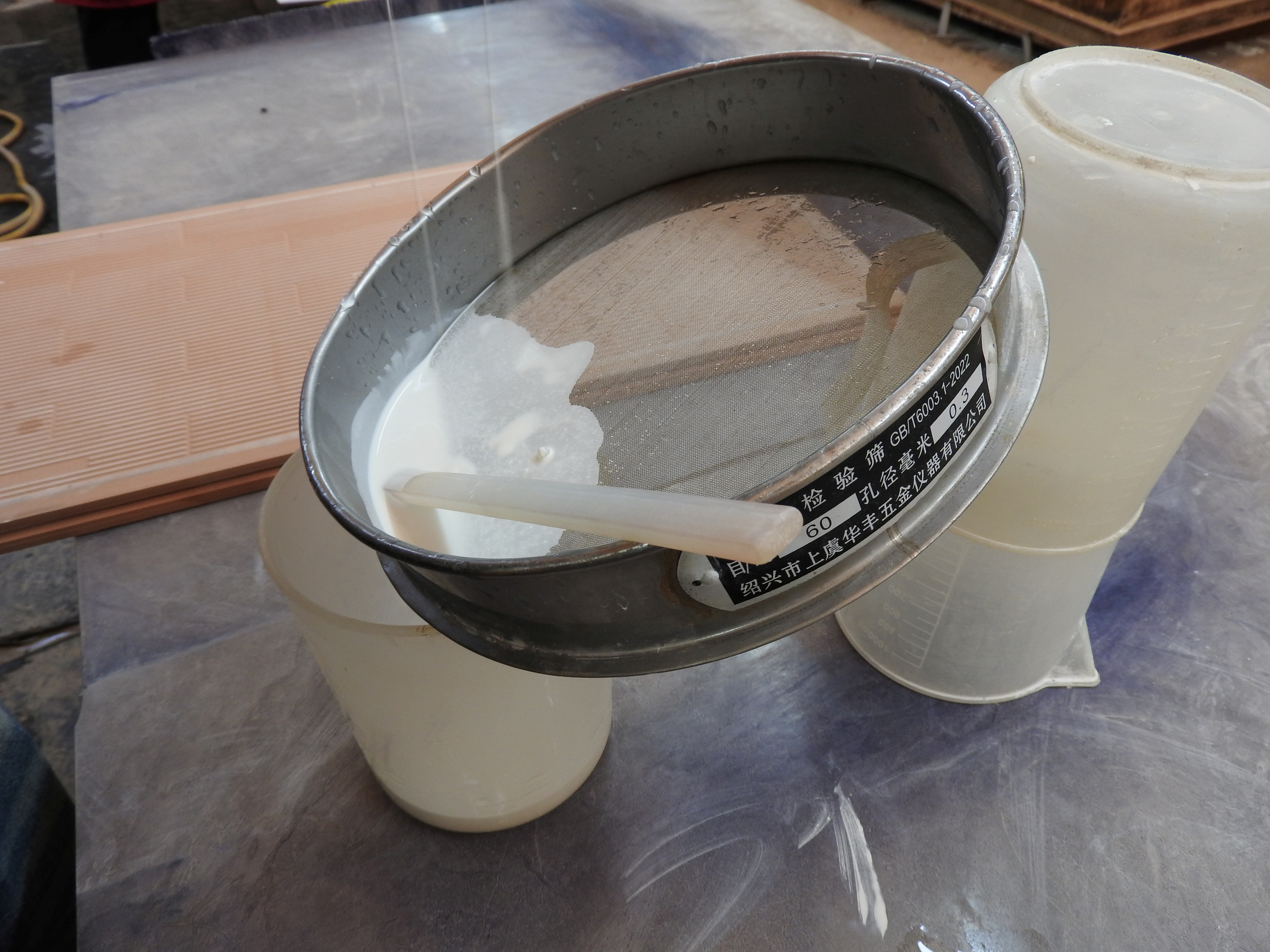
Compatibility is confirmed on the customer's body: samples are taken and tested at the customer's factory rather than inferred from a catalogue grade.
Because these variables are factory-specific, a frit that performs well in one plant can behave differently in another. This is why RENOVA's customization is defined around the customer's ceramic body, kiln type, firing temperature, production process and other factory-specific conditions, rather than around a standard catalogue specification alone.
Blistering Tendency: The Most Common Reason a Suitable Frit Fails
A blister is a gas bubble trapped in, or rising through, the engobe layer while it is still fluid. The gas can originate in the frit, the body, the slurry or the kiln. The frit's contribution is indirect but important: its softening behaviour sets how long the layer remains fluid enough to let gas escape, and its residual volatile content sets how much gas starts inside the layer.
Common Sources
- Residual moisture and undecomposed carbonate or sulfate in the frit or in the raw materials that partially replace it.
- Organic matter and carbonates in the body, releasing gas at the interface below the engobe.
- Air entrained in the slurry, combined with excessive applied thickness.
- Firing at the top of the window or with an aggressive heating rate, which extends the time the layer stays open.
- Kiln atmosphere and water vapour interacting with a layer that is still permeable.
How to Screen Before Scaling
Screen at the trial stage rather than at the kiln. Fire the trial at the upper end of the intended window, not only at the midpoint, and inspect the engobe surface both before and after the cover glaze is applied — some blisters only become visible once the glaze seals above them. Cross-section a fired sample to distinguish blisters that originate at the body interface from those that form inside the engobe itself.
Keeping a retained sample from every delivery gives the plant a reference when a defect appears months later, and lets the supplier compare a current batch against a known-good one instead of against memory. RENOVA's technicians test and retain samples from every batch of products for exactly this purpose.
A Seven-Step Selection Sequence
The sequence below is the order that keeps a frit evaluation from becoming a series of disconnected trials. Each step produces the input the next one needs.
- Collect the fixed data. Body composition and water absorption target, kiln type, firing curve including soak and cooling, application method and thickness, and the cover glaze to be used above the engobe.
- Define what the layer must deliver. Target water absorption, required whiteness or background tone, acceptable defect level and any colour constraint from the glaze system.
- Fix the firing window. Use 1050–1100 °C where low temperature and low expansion govern; use the 1080–1180 °C window for titanium frits RFT8-7-HL and RFT8-7-HH where opacification and thermal stability at higher peak temperature are required.
- Match expansion across the stack. Compare the frit reference against the body and cover glaze on the same unit and temperature basis; for RFT8-7-HH, treat CTE 290 as a starting reference and confirm its basis before calculating stress.
- Run a defect-focused trial. Fire at the top of the window, test water absorption, bond and whiteness, and record blister counts rather than describing them.
- Scale through a production trial. Move from laboratory tiles to a production run on the actual line, because kiln loading and line speed change the effective firing profile.
- Lock the batch reference and the adjustment path. Agree what a batch certificate contains, retain samples, and confirm how formulation fine-tuning will be handled if body or kiln conditions change.
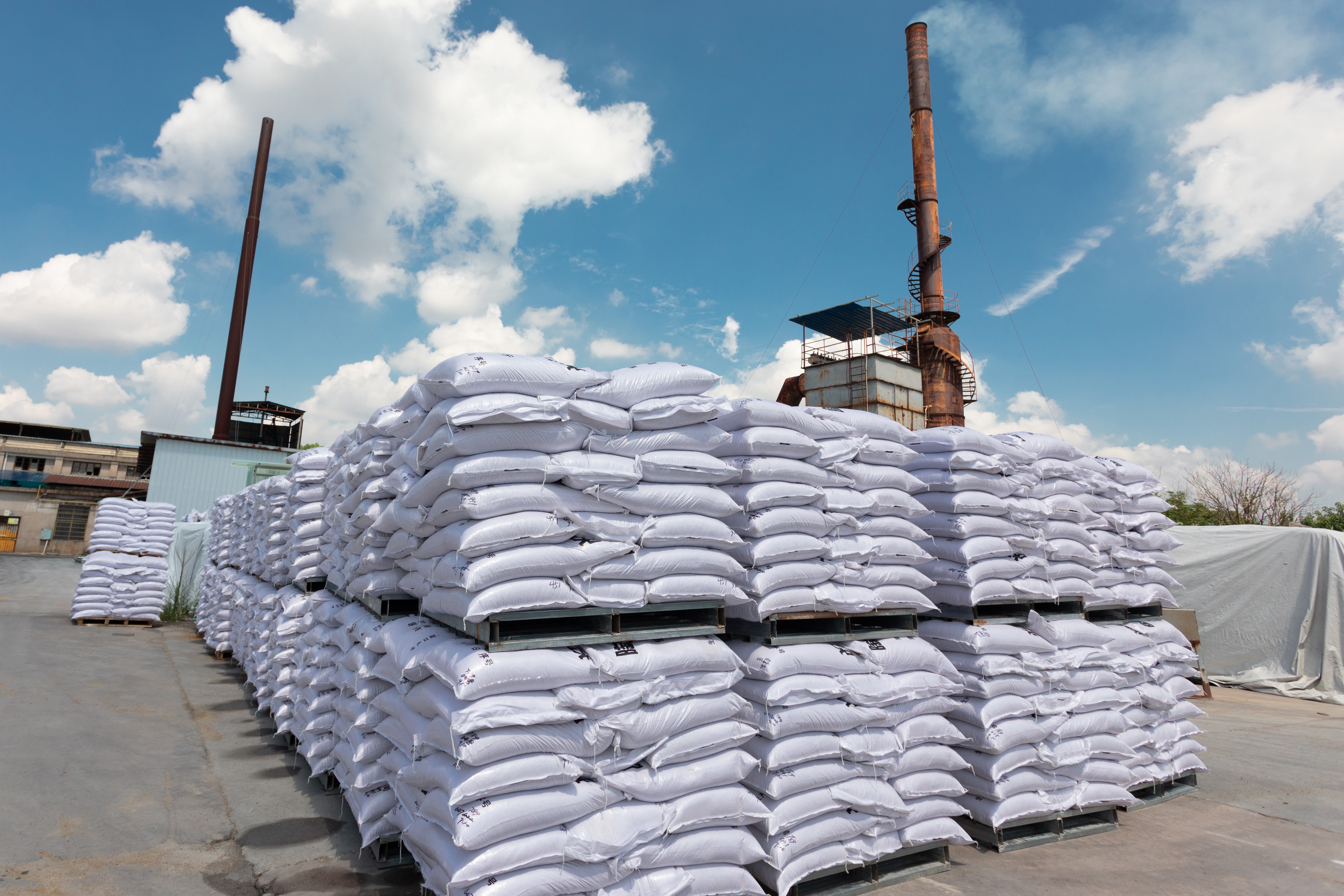
Frit production capacity: a 10,000 m² factory established in 2011, with combined annual capacity across production facilities of 40,000 tons.
Where These Choices Show Up in Production
Three situations account for most of the selection work. In double-fired wall tile, the glaze sequence constrains peak temperature, so the engobe is usually built around the 1050–1100 °C window with the emphasis on sealing and background whiteness. In single-fired floor tile and larger formats, higher peak temperatures and greater thermal mass push the choice toward the 1080–1180 °C titanium frit window, where opacification and thermal stability have to hold across the tile. Where a factory runs bodies from more than one source, compatibility becomes the dominant variable rather than temperature.
Documented supply experience points in the same direction. A ceramic tile manufacturer in Thailand received 1,000 tons of titanium frit over one year for ceramic glaze applications on wall and floor tiles; the frit showed stable performance in the production process and consistent results after firing, and technical support helped adapt it to the customer's production conditions. The grade family involved — RFT8-9-HL, RFT8-7-LL, RFT8-7-HL and RFT8-7-HH — is the same family discussed above for the 1080–1180 °C window. The case documents glaze applications rather than a dedicated waterproof engobe project, so it should be read as evidence of production consistency and adaptation support, not as a substitute for an engobe trial on your own body.
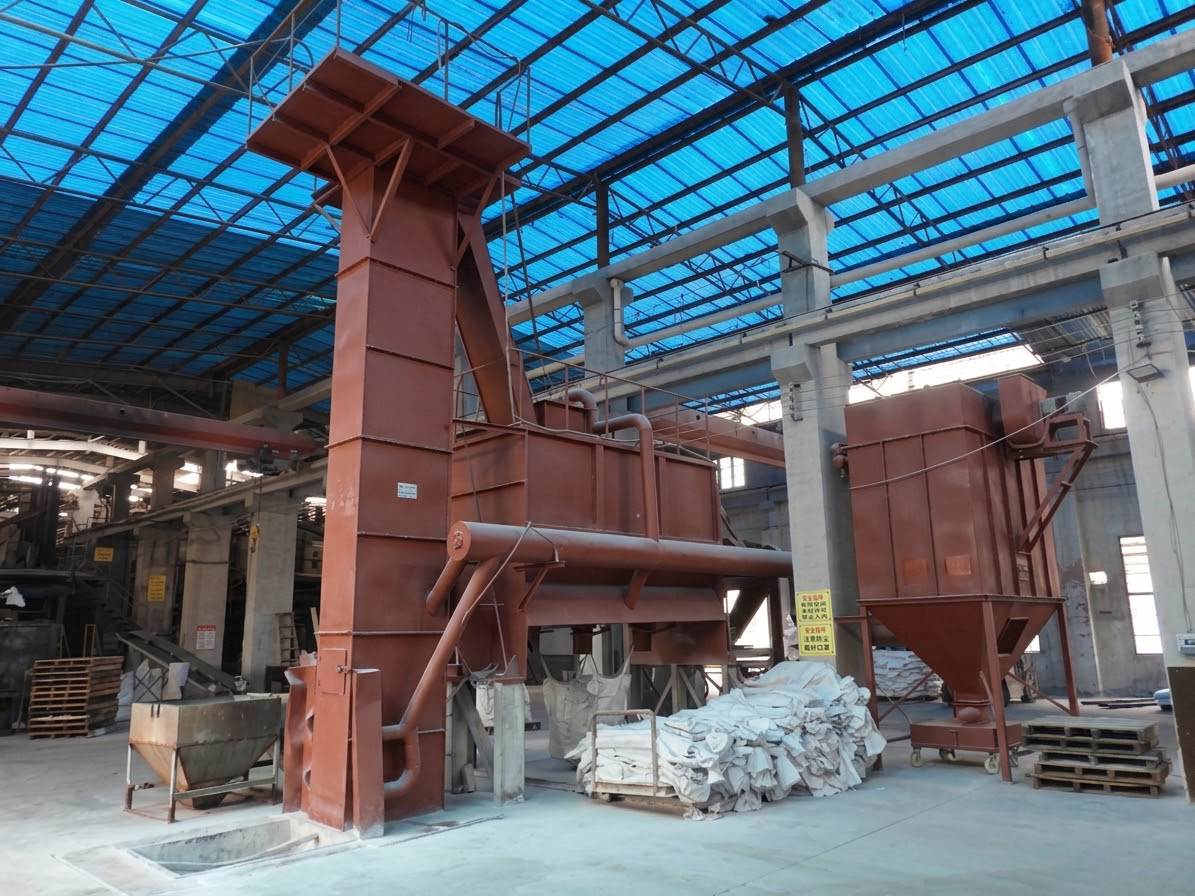
Batch handling and quality control: trial production and finished-tile evaluation are carried out against the customer's ceramic body and production conditions.
Selection Reference Table
The table below compares the two documented routes on the variables that decide a waterproof engobe specification. Values are the verified ranges and references stated above; anything not stated is left for trial confirmation rather than estimated.
| Selection variable | Low-temperature / low-expansion route | Titanium frit route (RFT8-7-HL / RFT8-7-HH) |
|---|---|---|
| Documented firing window | 1050–1100 °C | 1080–1180 °C |
| Expansion reference | Low-expansion frit, matched to body and cover glaze | RFT8-7-HH referenced at CTE 290 — confirm unit and interval |
| Primary contribution | Layer closure at reduced peak temperature | Opacification plus thermal stability at higher peak temperature |
| Where the risk sits | Bottom of the window: under-firing, residual absorption | Top of the window: blistering, over-firing |
| Confirm before ordering | Water absorption and bond after trial firing | Blister count, whiteness and CTE basis after trial firing |
Frequently Asked Questions
How do we confirm that a frit is compatible with our body before committing to a full order?
Compatibility is confirmed through trial production and finished-tile evaluation carried out against your own ceramic body and production conditions. Each factory differs in body materials, kiln type, firing temperature and process, so results can differ between plants even with the same grade. A supplier's technical team should support the trial on site, adjust the formulation where needed, and provide process guidance plus after-sales technical service until the finished result is acceptable.
Can a Chinese titanium ceramic frit manufacturer support OEM glaze development?
Yes, where the supplier runs formulation work rather than only catalogue sales. RENOVA provides customized ceramic frit supply and technical formulation support, with frit formulation and technical specifications adjusted to the customer's ceramic body, kiln type, firing temperature, production process and other factory-specific conditions. The same arrangement covers on-site technical support, formulation fine-tuning, production process support and after-sales technical service. Its titanium frit range includes RFT8-7-LL, RFT8-7-HL, RFT8-7-HH and RFT8-9-HL, supplied for ceramic glaze applications.
Which firing window should we specify for a titanium frit in a waterproof engobe?
RFT8-7-HL and RFT8-7-HH are specified in the 1080–1180 °C window, while low-temperature, low-expansion engobe applications are generally built around 1050–1100 °C. The two windows overlap, so the final choice depends on the body, the kiln curve and the target properties of the layer. Whichever window is selected, the trial should be fired at the upper end of it, because blistering and over-firing appear there first and are not visible at the midpoint.
Can we evaluate samples before placing an order?
Yes. Samples can be provided once a suitable product has been identified from your requirements and production conditions, and they can be used for testing and evaluation before an order is placed. For engobe work, the useful sample is one that can be fired on your own body under your own kiln curve, so that absorption, bond, whiteness and blistering can all be assessed together.
What are the MOQ and lead time?
MOQ and lead time depend on the specific product and order details, so they are quoted against the actual requirement rather than stated as a fixed figure. Sharing your product specification, target firing window and order quantity is enough to obtain the corresponding MOQ and an estimated lead time. A full product overview is available in the RENOVA ceramic frit catalogue, and samples or a technical discussion can be requested alongside it.
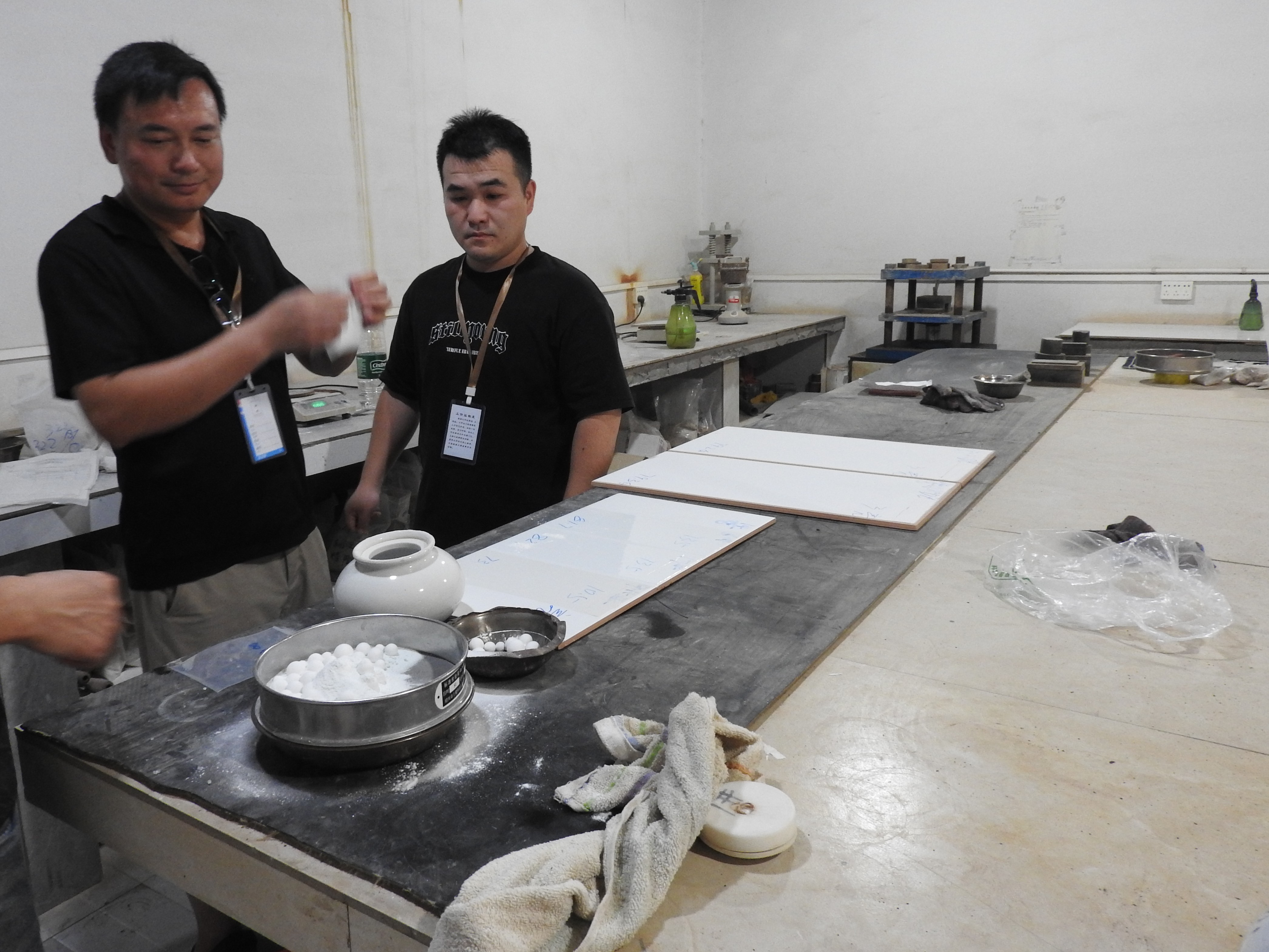
Next step: formulation fine-tuning and process support at the customer's factory, based on the trial result.
Conclusion
Ceramic frit selection for a waterproof engobe is a matching exercise, not a grade-selection exercise. The firing window sets the boundary — 1050–1100 °C for low-temperature, low-expansion work, 1080–1180 °C for titanium frits RFT8-7-HL and RFT8-7-HH — and the CTE reference, including the CTE 290 value for RFT8-7-HH, only becomes meaningful once its unit and temperature interval are confirmed against the body and cover glaze.
Between those fixed points, three checks decide the outcome: whether the fired layer reaches the target water absorption at the top of the window, whether expansion leaves the engobe in compression rather than tension, and whether blistering stays within the accepted defect level when the kiln is pushed to its upper limit. A trial that tests only the midpoint answers none of them.
RENOVA INDUSTRIAL & TRADING CO., LTD has supplied ceramic materials to ceramic manufacturers including Marco Polo, Monalisa, Hongyu and Arrow, and works with customers to fine-tune formulations against their body, kiln type, firing temperature and production process. For an engobe project, that adjustment path — trial, formulation fine-tuning, production trial, batch reference — is the part of the specification that data sheets cannot carry on their own.
Have Questions or Need More Details?
Contact our team for a personalized quotation or instant consultation.
Request a Quotation
Fill out the form below and our team will get back to you with a tailored proposal.
WhatsApp Direct Chat
Prefer to chat in real-time? Message us on WhatsApp for instant assistance & quick answers.
- Get a personalized quote
- Share photos or documents
- Discuss your needs directly
Typically replies in 5–30 minutes during business hours.