
Three Ceramic Frit Choices for Double-Fired Wall Tile Projects
Short answer: Three ceramic frit options cover most double-fired wall tile projects. Titanium Frit RFT8-7-HH carries approximately 7% titanium content and a CTE of 290. Titanium Frit RFT8-7-HL is specified for a 1080–1180°C firing range and can be paired with a low-temperature titanium frit on higher-temperature lines. A low-temperature ceramic frit is the match for bodies that fire at 1050–1100°C at low expansion. Which one fits depends on firing range, wall tile fit, thermal expansion adjustment and compatibility with the waterproof engobe formulation, not on price order or on frit type alone.
Double-fired wall tile is made by firing the body once, applying an engobe and glaze layer, then firing a second time. The second firing is where the surface is decided, and the ceramic frit in the glaze is the part of the formulation most sensitive to it. Matching a frit for ceramic tiles is therefore not a catalogue decision. It is a decision about a body, a kiln and an engobe system that already exist on the line.
Why Double-Fired Wall Tile Is a Difficult Case for Ceramic Frit
Three variables move at the same time on a double-fired line.
- Firing temperature. The glaze firing runs below the body firing, and the exact window differs from plant to plant. A frit that matures correctly at one point in that window can be underfired or overfired at another.
- Body expansion. After cooling, the glaze layer needs to sit in compression on the body. When the body runs at low expansion, the glaze side of that balance has to be adjusted too.
- Engobe formulation. The engobe is the intermediate layer that carries opacity and controls what reaches the body. Its composition changes how the glaze above it melts and how the two layers behave together.
When the three are mismatched, the symptoms show up on the finished tile: crazing, pinholes, weak adhesion between layers, uneven gloss, or colour that does not repeat from batch to batch. None of these are fixed by adding more of the same frit. They are resolved by changing the frit grade or adjusting the formulation around it.
The practical limit is that no single frit performs well across every double-fired body. A grade developed for a higher-expansion body will not behave the same way on a low-expansion body fired at 1050°C, and a grade tuned for a narrow high-temperature window will not rescue a line that runs cooler.
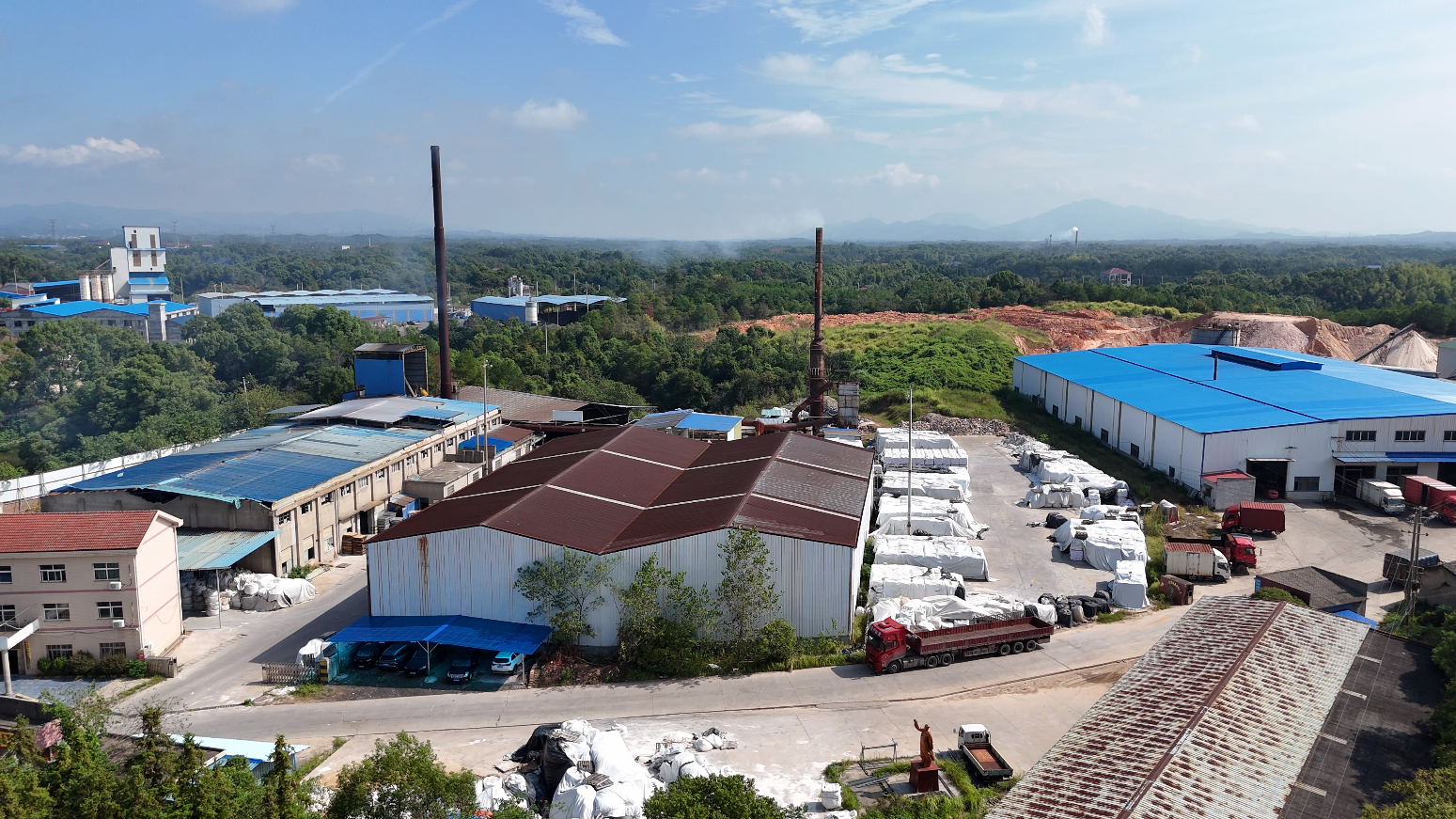
Industry Background: Where Frit Fits in the Wall Tile Supply Chain
Ceramic frit is a glassy material that has already been melted, quenched and milled, so it arrives at the tile plant with a more predictable firing behaviour than raw minerals mixed on site. That is why frit became the base of glaze formulations rather than an interchangeable additive.
Within that product family, alkaline-boron frit is the dominant type. A 2025 market analysis published by Future Market Insights lists alkaline-boron frit as the largest product type in the ceramic frit market, at approximately 38.7% of revenue. Production is concentrated as well: according to Market Research Future data for 2023, China accounts for about 65% of global ceramic frit production. For a buyer shortlisting frit for wall tile, most available sources will therefore be Chinese manufacturers and trading companies.
At the border, vitrifiable enamels and glazes are traded under HS code 3207.20, which is what an importer declares when shipping ceramic frit internationally.
The engobe layer has also developed separately from the glaze layer. A waterproof engobe formulation is now a standard part of double-fired wall tile design: the engobe is applied to the body first and forms a barrier and opacifying layer beneath the glaze. The engobe frit is usually selected apart from the titanium frit, zirconium frit or boron frit used in the cover glaze, because its job is different. The engobe has to bond to the body and seal its surface; the cover glaze has to deliver gloss, texture and wear behaviour.
That split is why the shortlist matters. A plant that evaluates a cover glaze frit without reference to the engobe beneath it is evaluating half the system.
The Three Frit Options for Double-Fired Wall Tile
Against those variables, three ceramic frit options cover the majority of double-fired wall tile conditions. Each is described below by firing range, wall tile fit, thermal expansion adjustment and compatibility with waterproof engobe formulations.
Option 1: Titanium Frit RFT8-7-HH
What it is. Titanium Frit RFT8-7-HH is a titanium-bearing ceramic glaze frit with approximately 7% titanium content and a reported CTE of 290. Titanium in a frit contributes opacity and influences how the fired glaze responds to thermal change, which is why titanium frit is the usual choice when a wall tile needs a white or fully opaqued surface rather than the see-through appearance of a transparent ceramic frit.
Firing range fit. RFT8-7-HH is used where the glaze firing sits in the upper part of the line's working window and the titanium content has to do its job within that heat cycle. The 7% titanium level is the defining characteristic of this grade.
Wall tile fit. Double-fired wall tile is a thin product covering a large body area, so the glaze cannot be too soft. An opaque titanium-bearing frit gives the opacified, non-translucent surface on the wall face without relying on a high-lead system.
Thermal expansion adjustment. The CTE of 290 is the figure to hold against the measured expansion of the body when deciding whether this grade is needed at all. The goal is a glaze that stays in compression after cooling. Where the body expansion combined with the engobe already sits high and a standard titanium frit no longer balances it, the HH grade is the compensation route.
Engobe compatibility. RFT8-7-HH is applied where the waterproof engobe underneath already carries part of the opacity and also takes part in the final expansion balance. Boron frit or zirconium frit in the engobe formulation shifts the expansion of that intermediate layer, which in turn changes how much compensation the cover glaze has to supply. Confirm the engobe composition before switching to HH, because a grade matched to one engobe can over-compensate against another.
Option 2: Titanium Frit RFT8-7-HL
What it is. Titanium Frit RFT8-7-HL is a titanium-based ceramic frit specified for a 1080–1180°C firing range. That window covers the glaze firing of most double-fired wall tile lines.
Firing range fit. The 1080–1180°C band is wide enough that a line can move within its glaze curve, through batch variation, kiln load or cover glaze adjustment, and still stay inside the frit's working range. That tolerance matters on double-fired wall tile, because the glaze firing comes after the body firing and is harder to change once the body cycle is fixed.
Wall tile fit. On double-fired wall tile the HL grade sits in the balance between opacity and firing behaviour. It does not drive the surface to excessive opacity, and it does not leave it too transparent for a wall face that has to read as uniform under indoor light.
Thermal expansion adjustment. RFT8-7-HL can be combined with a low-temperature titanium frit on higher-temperature lines. That combination is worth noting because it allows a plant to tune the expansion and firing behaviour of the glaze without leaving the 1080–1180°C window, instead of replacing the whole frit system on the line.
Engobe compatibility. Because the HL window is wide, it tolerates some variation in engobe composition without that variation showing up on the finished tile. That is useful while a waterproof engobe formulation is still being adjusted and the final recipe has not been locked: a frit with a wide firing range leaves room for the engobe development to proceed.
Option 3: Low-Temperature Ceramic Frit for 1050–1100°C Low-Expansion Bodies
What it is. A low-temperature ceramic frit is a glaze frit that matures around 1050–1100°C. In the RENOVA product range, boron frit belongs to this low-temperature family. It is used when the body itself is already low in expansion.
Firing range fit. 1050–1100°C is the low-temperature window. Pushing a high-temperature ceramic frit into that curve leaves the glaze underfired, and pushing a low-temperature frit into a hotter kiln overfires it and loses the surface effect. The two families are not interchangeable across the window.
Wall tile fit. A low-expansion body needs a low-temperature, low-expansion glaze system rather than a high-temperature titanium frit pressed into the same curve. In this case the low-temperature grade is not a compromise; it is the physically correct choice for that body.
Thermal expansion adjustment. Where the body already runs at low expansion, a glaze that is too high in expansion produces tension on cooling rather than compression, and crazing is the result. The low-temperature frit is the grade that brings the glaze side of the balance down to meet a low-expansion body.
Engobe compatibility. A low-temperature engobe matures at a lower temperature, and the frit type in that engobe has to match. Boron frit or zirconium frit in the engobe behaves differently at 1050–1100°C than it would in a hotter kiln, so the cover glaze frit has to be matched to that reality rather than to a high-temperature reference curve.
Side-by-Side Comparison of the Three Frit Options
| Frit / grade | Reported characteristics | Firing range fit | Thermal expansion role | Engobe note |
|---|---|---|---|---|
| Titanium Frit RFT8-7-HH | Approximately 7% titanium content; CTE 290 | Upper part of the line's glaze window | Compensation route where body plus engobe expansion is already high | Confirm waterproof engobe composition first, since the engobe carries part of the balance |
| Titanium Frit RFT8-7-HL | Specified for 1080–1180°C | Wide window covering the usual double-fired glaze firing | Can be combined with a low-temperature titanium frit on higher-temperature lines | Tolerates engobe variation while a waterproof engobe formulation is still being adjusted |
| Low-temperature ceramic frit (boron frit family) | Matures at 1050–1100°C | Low-temperature lines | Brings glaze expansion down to meet a low-expansion body | Must be matched to a low-temperature engobe that matures in the same window |
Step-by-Step: Evaluating a Frit for a Double-Fired Wall Tile Line
- Fix the body expansion and the firing curve first. Record the body's measured expansion and the actual glaze firing temperature range. Without these two figures the shortlist cannot be narrowed, because each of the three options above is defined by its firing window.
- Confirm the engobe composition. The waterproof engobe formulation determines how much expansion the cover glaze has to compensate and how much opacity the engobe already carries. Confirm the engobe frit before deciding between HH, HL and a low-temperature grade.
- Select the frit type against the real curve, not against price order. A low-temperature ceramic frit on a hot line and a high-temperature titanium frit on a cool line both fail, and neither failure is a price question.
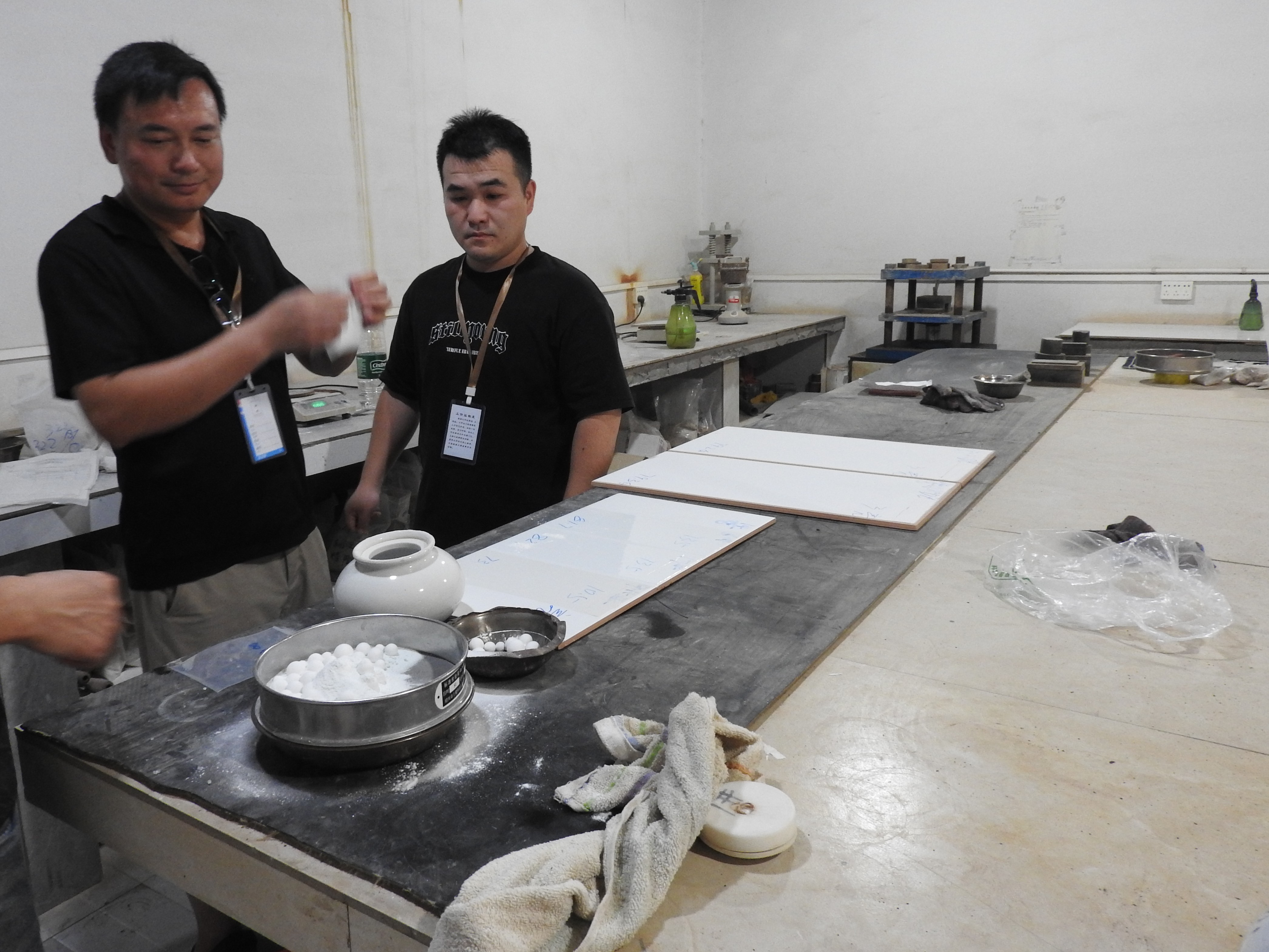
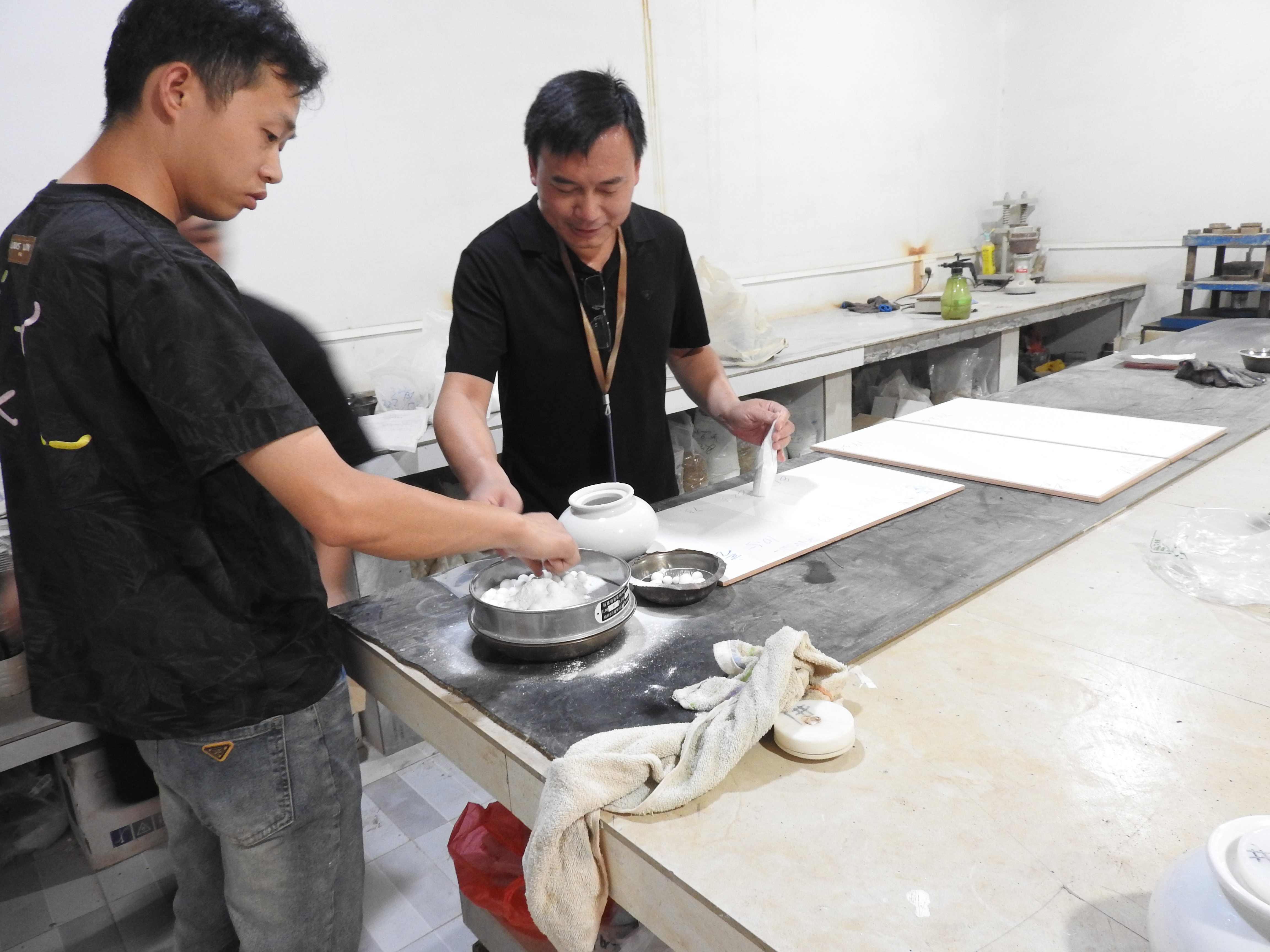
- Run a trial production and evaluate the finished tile. RENOVA evaluates trial production and finished tiles against the customer's own ceramic body and production conditions, which is the only reliable test of whether the frit fits.
- Adjust the formulation around the frit if the symptoms persist. When a finished product does not reach the expected effect, the cause is usually the match between the frit and the body materials, kiln type, firing temperature or production process, not the frit in isolation.
Where Each Option Fits in Practice
- Standard double-fired wall tile with a white cover glaze. Titanium Frit RFT8-7-HL at 1080–1180°C is the natural starting point, with the engobe carrying the barrier function beneath it.
- A line already committed to a higher temperature cycle. RFT8-7-HL combined with a low-temperature titanium frit gives a way to tune expansion without abandoning the existing cycle.
- Low-expansion bodies fired at 1050–1100°C. The low-temperature ceramic frit family, including boron frit, is the only realistic option; a high-temperature titanium frit does not mature inside that window.
- Projects where the waterproof engobe recipe is still moving. The wide HL window absorbs engobe variation that a narrower or more highly compensated grade would not.
- Projects where the engobe already carries high opacity and high expansion. RFT8-7-HH, with approximately 7% titanium content and CTE 290, is the grade aimed at that combination.
Field evidence for titanium frit on wall and floor tile applications exists in RENOVA's own supply record: a ceramic tile manufacturer in Thailand received 1,000 tons over one year for ceramic glaze applications on wall and floor tiles. The titanium frit showed stable performance in the production process and delivered consistent results after firing, and the technical support helped adapt the frit to that plant's production conditions.
Frequently Asked Questions
How are RENOVA ceramic frits quality-controlled for custom wall tile projects?
Quality control is based on the customer's ceramic body and production conditions, not on a factory specification alone. Technicians test and retain samples from every batch, and trial production plus finished-tile evaluation is carried out against the customer's ceramic body and production process before a formulation is confirmed.
Can you recommend a suitable ceramic frit for our double-fired wall tile and engobe system?
Yes. A recommendation is made from the specific production conditions, including raw materials, kiln type, firing temperature and production process. For double-fired wall tile the technical team evaluates the cover glaze frit and the waterproof engobe formulation together rather than assessing the frit on its own.
What is your minimum order quantity and delivery time?
MOQ and lead time depend on the specific product and the order details. Send the product requirement and order quantity, and the corresponding MOQ and estimated lead time can be confirmed for that item.
Can we get samples before placing an order?
Yes. Samples can be provided once a suitable product has been identified against your requirements and production conditions, and they can be used for testing and evaluation before an order is placed.
What happens if the finished tile does not reach the expected result?
Each factory has different production conditions, including body materials, kiln type, firing temperature and production process, and these differences affect the final result. RENOVA provides on-site technical support, formulation adjustment, production process guidance and after-sales technical service to optimize the application. Share the current body, kiln type, firing curve and engobe recipe, and the technical team can match a frit and arrange a sample on that basis.
Next step. Send the body expansion, kiln type and glaze firing curve for your double-fired wall tile line, and RENOVA INDUSTRIAL & TRADING CO., LTD will confirm whether RFT8-7-HH, RFT8-7-HL or a low-temperature frit is the correct starting point, then arrange a sample for trial production. The full product range is available in the RENOVA ceramic frit catalog.
Conclusion
The shortlist for double-fired wall tile comes down to three ceramic frit choices, and the deciding factors are the firing range, the wall tile body, the thermal expansion balance and the waterproof engobe beneath the glaze. Titanium Frit RFT8-7-HH, with approximately 7% titanium content and CTE 290, serves the conditions where compensation is needed. Titanium Frit RFT8-7-HL, specified for 1080–1180°C, covers the usual double-fired window and can be combined with a low-temperature titanium frit on hotter lines. A low-temperature ceramic frit, including the boron frit family, is the fit for 1050–1100°C low-expansion bodies. Selection should be confirmed by trial production on the actual line, because the body, kiln and engobe conditions are what the frit has to work with.
RENOVA INDUSTRIAL & TRADING CO., LTD · Room A301, Area A&B Ceramic Equipment Center CCIH, No. 68 Jihua Road, Chancheng, Foshan, Guangdong, China · rick@renovafs.com · +86 189-2598-9980 · renovafs.com
Have Questions or Need More Details?
Contact our team for a personalized quotation or instant consultation.
Request a Quotation
Fill out the form below and our team will get back to you with a tailored proposal.
WhatsApp Direct Chat
Prefer to chat in real-time? Message us on WhatsApp for instant assistance & quick answers.
- Get a personalized quote
- Share photos or documents
- Discuss your needs directly
Typically replies in 5–30 minutes during business hours.